ARK TMS Freight Broker Software
Freight broker software manages customer quotes, loads, carriers, tracking, documents, billing, and reporting in one operating workflow. ARK TMS applies that model in the cloud for domestic LTL and FTL brokerages with 1–50 employees.
ARK TMS at a glance
The key facts most brokerages ask about first.
- Who it is for: 1-50-employee freight brokerages, especially growing 15-40-user teams
- Implementation: guided core-workflow validation
- Implementation cost: confirm in the current written offer
- Training: guided training available; confirm current scope
- Support: human support; confirm current coverage and response target
- Deployment: cloud/web
- Mobile app: available for drivers and on-the-go workflows
Follow an ARK load through billing
Review source documents, rate confirmations, PODs, customer invoices, carrier bills, and the QuickBooks handoff with checks your team can run.
Read the document-to-accounting workflowFeatures
The core workflows ARK puts in one system for growing broker teams.
Dispatch
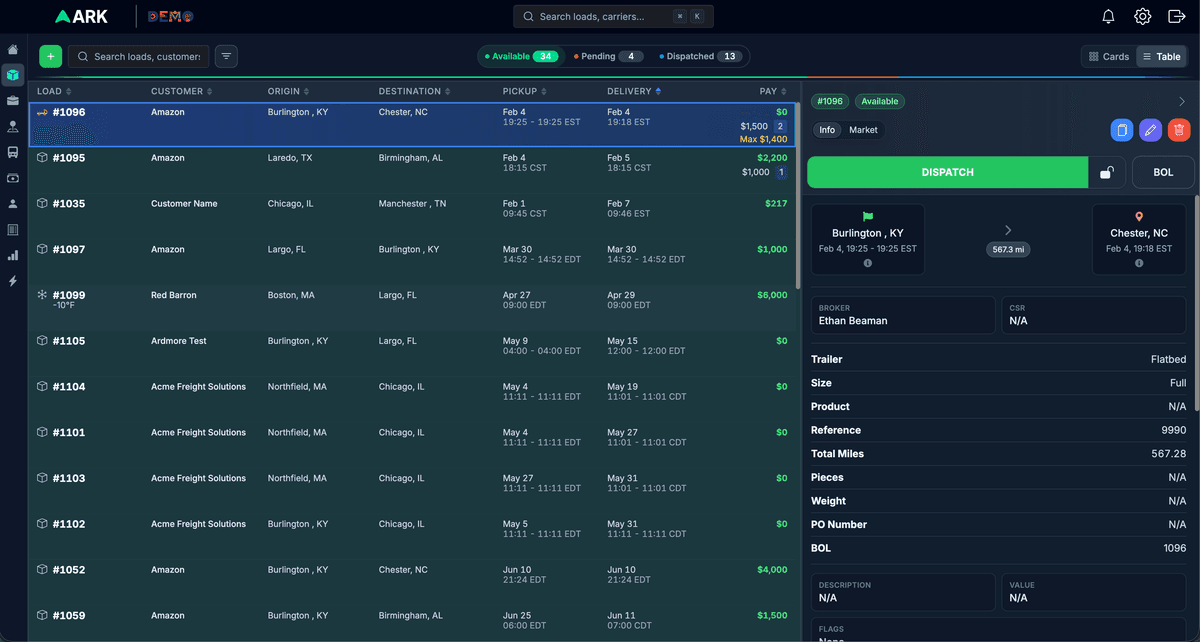
Dispatch keeps loads, carrier coverage, and paperwork in one workspace so reps can cover freight faster with fewer tab switches.
Carrier Onboarding
Carrier onboarding centralizes packets, credentials, and vetting so broker teams can approve capacity without chasing documents by email.
Accounting / QuickBooks
Accounting sync pushes invoices, bills, and payment data into QuickBooks to reduce duplicate entry and shorten billing turnaround.
Tracking
Tracking brings live shipment status and customer updates into the load record so brokers spend less time on check calls and exception emails.
Analytics
Analytics turns lane, margin, and user-level activity into coaching and pricing visibility so owners can spot bottlenecks earlier.
Mobile
Mobile workflows give drivers and brokers access away from the desk so updates, documents, and tracking are easier to capture in real time.
Proof behind the claims
These are public third-party case studies in the broker TMS category. They show the kinds of outcomes buyers often ask about, but they are not direct validation of ARK-specific benchmark claims.
Bahr Transportation
Descartes published that Bahr used integrated TMS and visibility workflows to book reefer loads up to 15 times faster.
Read Bahr case studyBahr Transportation
The same public case study reports a 30%-40% reduction in time spent tracking loads after moving from manual workflows.
Read Bahr case studyFreight Scouts
Freight Scouts describes running roughly 1,200 TL/LTL loads per month and eliminating admin-heavy check calls across about 40 daily loads.
Read Freight Scouts case studyCapital Logistics
Capital Logistics publicly attributes its growth plan to operational efficiency and visibility improvements that let the team handle more freight with fewer people.
Read Capital Logistics case studyNamed broker case studies
Public freight-broker case studies that show the kinds of throughput, tracking, and service outcomes this category of workflow software can unlock.
Bahr Transportation
Before: Manual procurement, heavy track-and-trace work, and limited visibility across 100-300 reefer loads per month.
After: Bookings up to 15x faster, tracking time down 30%-40%, and 98% on-time delivery performance.
Takeaway: visibility plus workflow automation can materially improve speed and service in time-sensitive reefer operations.
Freight Scouts
Before: Manual check calls across roughly 40 loads a day and growing complexity at about 1,200 TL/LTL loads per month.
After: Automated status updates every four hours replaced routine check calls, lowering operating costs without adding staff.
Takeaway: when tracking and dispatch share one workflow, brokers can absorb more volume with less repetitive service work.
Capital Logistics
Before: Revenue plateaued near $25M in 2016 while the team needed better visibility and more efficient execution.
After: Leadership reported the business was positioned to reach $100M by 2020 while handling greater freight volume with fewer people.
Takeaway: operational leverage matters most when a brokerage wants growth without linear headcount expansion.
Integrations matrix
A more specific look at what connects to ARK, what moves between systems, and how often those updates happen.
| System | Data synced | Direction | Update frequency |
|---|---|---|---|
| QuickBooks Online | Customer invoices, carrier bills, customers, vendors, payments, chart-of-accounts mappings | ARK to QuickBooks | Near real time after create or update |
| MacroPoint | Tracking requests, live GPS location, ETA, pickup/delivery confirmations, exceptions | Bi-directional workflow | Live events with location refreshes about every 15 minutes |
| Trucker Tools | Driver tracking, status updates, ETA, BOL/POD uploads, carrier communication | Bi-directional workflow | Event-driven with active-session updates |
| MyCarrierPortal | Carrier profiles, COIs, MC/DOT status, W-9s, credential changes | One-directional into ARK | At onboarding and whenever carrier credentials change |
| Sylectus | Expedite load posting, carrier availability, acceptance updates, communications | Bi-directional workflow | On publish and status change |
Named alternatives
A neutral comparison set for brokers evaluating ARK against other widely discussed freight-broker TMS options.
Vendor-owned sources were checked on July 16, 2026. Confirm current pricing, implementation, scope, and integration terms directly with each vendor.
Compare all 11 platforms in the sourced 2026 guide| Platform | Public price guidance | Published implementation guidance | Vendor positioning / scope | Notable integrations | Source |
|---|---|---|---|---|---|
| ARK TMS | Current configured seat price | Guided core-workflow validation | Freight brokerages and 3PLs evaluating broker-focused load, carrier, tracking, document, and accounting workflows; validate scope for the buyer's modes and rollout | QuickBooks Online, MacroPoint, Trucker Tools, MyCarrierPortal | ARK pricing page |
| AscendTMS | Basic $69/user/month; Premium $119; Pro $149 | Vendor says accounts can start immediately; confirm onboarding for selected integrations | Vendor positions plans from startups through enterprise across brokers, carriers, 3PLs, and shippers | Vendor lists 140+ integrations; DAT and Truckstop access require separate paid subscriptions | AscendTMS pricing (checked 2026-07-16) |
| Tai TMS | $995–$7,925/month published plans; larger-broker options available | Dedicated launch is listed with published plans; timing is not stated | Published tiers span 2–25 staff logins and 200–2,500 included shipments | Partner integrations and API consultation; included customer EDI counts vary by plan | Tai TMS pricing (checked 2026-07-16) |
| Rose Rocket | Full Service starts at $2,080/month; Enterprise custom | Vendor advertises a 90-day Full Service go-live; Enterprise can extend beyond 90 days | Configurable broker/carrier TMS with Full Service and Enterprise plans | ELD, accounting, and EDI access; custom integrations and unlimited API listed for Enterprise | Rose Rocket pricing (checked 2026-07-16) |
| Alvys | Usage-based; one official page starts at $514/month; confirm the applicable quote | Vendor says most companies are live in a few days; confirm scope and timing | Vendor positions the product for carriers, brokers, hybrid operations, private fleets, and enterprise | Vendor reports 120+ integrations, native EDI, and an open API | Alvys published entry pricing and scope (checked 2026-07-16) |
Validate ARK's core workflow with your team
Use this checklist to validate the core workflow with a success standard for each step.
Success criteria: Your logo, billing details, and rep accounts are live in the workspace.
Success criteria: Core records are searchable without duplicate contacts or carrier profiles.
Success criteria: A test invoice and carrier bill sync without manual edits.
Success criteria: A live test load shows status updates and customer recipients get milestone emails.
Success criteria: Documents generate from one load record with your brokerage branding applied.
Success criteria: The team covers a load, tracks it, and posts the invoice to QuickBooks without workarounds.
Is ARK right for you?
A candid fit check so the page matches real buying intent instead of trying to fit every brokerage model.
Good fit
- Domestic LTL and FTL freight brokerages with 1-50 employees, including growing 15-40-user teams
- Teams that want cloud deployment, fast setup, and straightforward per-user pricing
- Brokerages trying to reduce duplicate entry between dispatch, billing, and tracking
- Owners who want rep-level productivity, margin, and lane visibility without enterprise rollout overhead
Probably not the best fit
- Complex multimodal forwarding programs spanning ocean, air, customs, and warehouse orchestration
- Large managed-transportation organizations that need deep shipper procurement or control-tower configuration
- Broker-carriers that need asset fleet routing, dispatch, maintenance, and ELD-first workflows in one stack
- Teams that require a publicly stated SOC 2 or ISO 27001 certification before starting a security review
Frequently Asked Questions
ARK TMS is freight broker software for domestic brokerages with 1-50 employees, including growing 15-40-user teams. It is positioned for lean LTL and FTL teams that want dispatch, billing, tracking, and carrier workflows in one cloud system without enterprise-software overhead.
Implementation time depends on data volume, integrations, and workflow complexity. ARK provides guided core-workflow validation covering user setup, data import, QuickBooks connection, tracking setup, and a test load from dispatch through invoice sync.
Yes. ARK is a fit for domestic LTL and FTL broker workflows. The platform is less suited to highly customized multimodal forwarding or managed-transportation programs that need deeper cross-mode orchestration.
ARK syncs accounting records automatically once the integration is connected. The typical goal state is that invoices, bills, and payment-related records post into QuickBooks without re-keying or after-the-fact corrections.
Encryption should be part of the security review, not a hidden assumption. Confirm current encryption in transit, encryption at rest, backup handling, and key-management details with ARK during procurement before you rely on this page alone.
This page does not represent ARK as SOC 2 or ISO 27001 certified. If those certifications are decision-critical, request the latest security packet and formal status in writing before moving forward.
This page does not publish a numeric uptime SLA. Ask for the current uptime commitment, incident response process, maintenance windows, and service credits during evaluation so legal and IT can review the actual terms.
ARK is positioned as a cloud deployment, but this page does not publish a binding residency statement. Confirm hosting region, backup region, and any U.S.-only or contract-specific residency options during the security review.
ARK advertises human support. Confirm the current response target, business-hours window, escalation path, weekend coverage, and time zone alignment before signing.
TMS means transportation management system. For a freight broker, that usually means software used to quote, cover, track, document, bill, and report on loads in one operating workflow.
LTL means less-than-truckload. It describes freight that does not fill an entire trailer and is usually consolidated with shipments from other customers.
FTL means full truckload. It usually refers to freight that uses a dedicated trailer for one customer shipment from pickup through delivery.
EDI means electronic data interchange. In freight brokerage, it usually refers to structured document exchange such as tenders, status messages, and invoices between systems instead of email or manual entry.
Sources and methodology
Public source links used on this page, plus a note on how to interpret comparison data that is still quote-based or packaging-dependent.
Bahr Transportation
Public third-party broker TMS case study describing bookings up to 15x faster, 30%-40% less time spent tracking loads, and 98% on-time performance in reefer operations.
Freight Scouts
Public third-party broker TMS case study describing approximately 1,200 TL/LTL loads per month and the elimination of check calls across roughly 40 daily loads.
Capital Logistics
Public third-party broker TMS case study describing a revenue plateau near $25M and a path toward $100M supported by efficiency and visibility improvements.
Competitor comparison note
Price and setup fields in the alternatives matrix are presented as public pricing posture or implementation posture. Quote-based vendors should be validated directly during evaluation because packaging and services vary by account.
Ready to evaluate ARK TMS?
Start with the implementation checklist, verify the integrations you need, and test the workflow with a live load before you buy.
- Cloud deployment; confirm implementation scope and cost
- Guided onboarding and training available; confirm current scope
- Confirm required integration availability and packaging
- Human support; confirm current coverage and response target